Describe the Role of Two Different Enzymes in Dna Replication
Helicases are very important in DNA replication because they are responsible for opening the double helix by breaking the hydrogen bonds. So an enzyme that attaches many pieces of DNA.
Molecular Mechanism Of Dna Replication Article Khan Academy
Complementaryspecific base pairing AT and GC.
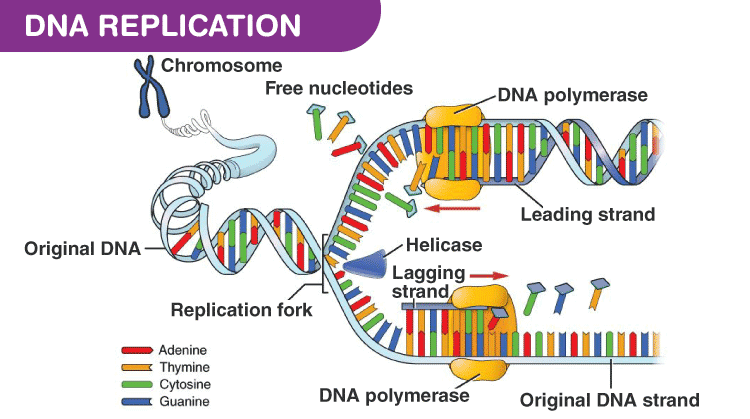
. Describe the role of two named enzymes in the process of semi-conservative replication of DNA DNA helicase breaks the hydrogen bonds between DNA strands separating the double-stranded DNA into single strands and exposing the nucleotide basesDNA polymerase joins adjacent DNA nucleotides through formation of phosphodiester bonds forming the sugar-phosphate. Individual strands of DNA are manufactured in different directions producing a leading and a lagging strand. Semi-conservative replication new DNA molecules contain one old strand and one new strand.
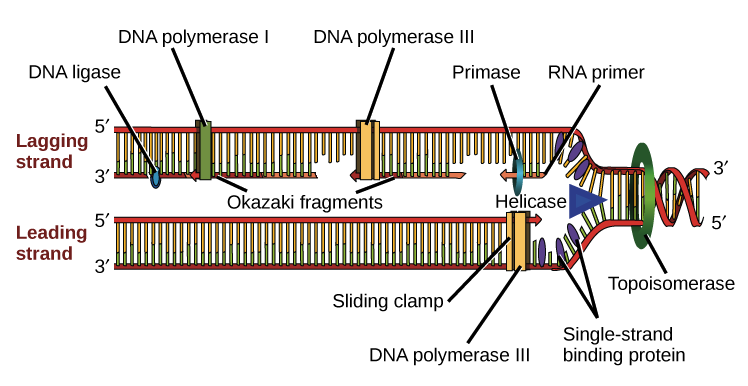
Helicase unwinds the DNA double helix Gyrase relieves the buildup of torque during unwinding Primase lays down RNA primers DNA polymerase III main DNA synthesis enzyme DNA polymerase I re. Coli polymerase III is the main replication enzyme while polymerase I II IV and V are responsible for error checking and repair. DNA Helicase DNA Polymerase 2 DNA helicase - unwinding DNA and breaking hydrogen bonds DNA polymerase - joins adjacent nucleotides Contrast the structures of ATP and a nucleotide found in DNA to give two differences 2 - ATP has ribose and DNA nucleotide has deoxyribose.
The double helix of the original DNA molecule separates blue and new strands are made to match the separated strands. Helicases are the enzymes that help in unwinding both the strands of DNA for the process of DNA replication to take place. Ligase Ligase is the enzyme which joins together the Okazaki fragments of the discontinuous DNA strands.
1 DNA Helicase. Also proofreads and corrects some errors. Both strandseach strand acts as a templates.
Helicase enzyme opens up the DNA double helix by breaking hydrogen bond between two strands of DNA and provide single template strand. Therefore the mutant of pol A are deficient in DNA polymerase I or Kornberg enzyme. DNA polymerase III binds to the strand at the site of the primer and begins adding new base pairs complementary to the strand during replication.
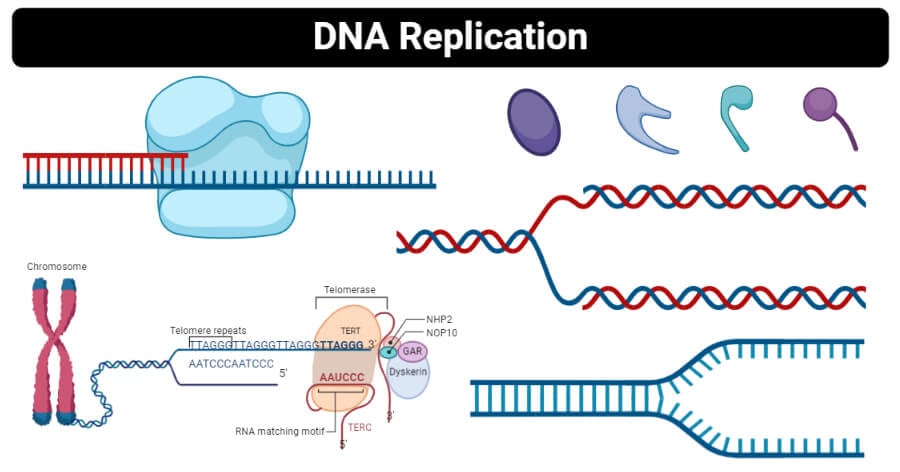
DNA polymerase joins nucleotides on new strand. Coli topoisomerase I can remove negative supercoils without leaving nicks in the DNA molecule Figure 1214. DNA replication is the cellular process involved in the synthesis of an exact copy of an existing DNA molecule.
Pol A is a gene responsible for the synthesis of polymerase I. Coli DnaG functions as primase. A variety of enzymes are involved in the process of DNA replication.
Single-Stranded Binding Protein SSBP 2DNA Helicase 3. DNA Primase is another enzyme that plays an important role in DNA replication. Lagging strands are created by the production of small DNA fragments called Okazaki fragments that are eventually joined together.
Table of Contents Enzymes involved in DNA Replication 1. Type I Topoisomerases Relax DNA by Nicking and Then Closing One Strand of Duplex DNA The first topoisomerase to be discovered E. View the full answer.
Question 5 6 pts Why is it necessary that leading strand DNA. Replication means Synthesis of daughter nucleic acid molecules identical to the parental nucleic acids. DNA Primase One of the most crucial enzymes is DNA Primase.
This enzyme activity catalyzes the synthesis of RNA primers to initiate DNA replication. The prokaryotic DNA polymerase II was discovered in pol A mutant of Ecoli. DNA polymerase adds nucleotides via complementary base pairing A-T and C-G to the 3 end of the template strand one by one in a 5 to 3 direction thus synthesizing the new complementary DNA.
As we know that DNA replication is semi-conservative therefore the 2 strands of the DNA which are held by hydrogen bonding needs to be separated before other enzymes like DNA polymerases can act upon on of the strand and make its copy. In bacteria such as E. What is the role of an enzyme.
DNA polymerase α catalyzes priming of both the strands. DNA replication begins at places called origins within the DNA molecule and the creation of replication forks. A result of replication occurring in the 5 to 3 directionOn the leading strand RNA primase synthesises a short RNA primer that allows DNA polymerase III to bind to and begin adding DNA nucleotides in a 5 to 3 direction.
Provides the starting point for DNA polymerase to begin synthesis of the new strand. Important Enzymes in DNA Replication. They actually speed up the rate of a chemical reaction to help support life.
DNA polymerase y is found in mitochondria and catalyzes replication of mtDNA. Enzymes involved in DNA replication are. Describe the role of topoisomerase enzymes in DNA replication.
Helicase requires ATP as energy source. The process of strand separation is made possible because of the enzyme Helicase which separates the two strands using the energy derived from ATP hydrolysis. It is responsible for in vivo DNA replication.
4 pts Question 4 Describe the role of helicase enzymes in DNA replication. It synthesizes a small RNA primer which acts as a kick-starter for the enzyme DNA polymerase. DNA polymerases ξ η τ and k are all nuclear DNA repair enzymes.
Synthesizes the new DNA strand. Describe the function of each of these enzymes. Enzymes create chemical reactions in the body.
It adds nucleotides to the 3end of the growing strand one nucleotide at a time. 4 DNA helicase is the enzyme that separates two strands of double-stranded DNA to. The DNA polymerase is responsible for synthesizing the new DNA chains through base pairing.
Helicase Helicase is the enzyme which unzips the DNA strands by breaking the hydrogen bonds between them. Unwinds the double helix at the replication fork. During DNA replication DNA polymerase reads the existingtemplate DNA strand while synthesizing a new complementary DNA strand to the template.
The replication process then splits into two different processes occurring on the leading and lagging strands of DNA. Answer 1 of 10. The process of DNA replication is catalyzed by a type of enzyme called DNA polymerase poly meaning many mer meaning pieces and ase meaning enzyme.
DNA-B is a primary replicative Helicase it binds and move on lagging strand in 5 to 3 direction unwinding the duplex as it goes. Enzymes of DNA Replication Helicases. Unwind the DNA helix at the start of replication.
Helicase unwinds the DNA double helix Gyrase relieves the buildup of torque during unwinding Primase lays down RNA primers What enzyme opens DNA. DNA polymerase is the enzyme that is completely responsible for the creation and expansion of the new strands of the DNA-specific coding regions. In the replication nucleic acids will be double by the Enzymes Involved in DNA Replication.
But in absence of DNA polymerase I replication of DNA also takes place in such mutant type. Thus it helps in the formation of the replication fork. In this section we describe the two different classes of topoisomerases and their role in DNA replication.

Major Enzymes Biology For Majors I
Dna Replication Definition Enzymes Steps Mechanism Diagram
Dna Replication Process With Diagrams Class 12 Prokaryotic Eukaryotic Dna Replication


Comments
Post a Comment